The Kashi Vishwanath Temple is one of the most revered and ancient temples in India, located in the holy city of Varanasi on the banks of the sacred Ganges River.
Dedicated to Lord Shiva, it holds a central place in Hindu religious tradition and is considered one of the twelve Jyotirlingas, making it a major pilgrimage site.
The temple is not just a spiritual center but also a symbol of India’s enduring faith and cultural richness, attracting millions of devotees and tourists every year.
Historically, the Kashi Vishwanath temple has undergone several reconstructions due to repeated invasions and demolitions.
The current structure was built in 1780 by Ahilyabai Holkar, the Maratha queen of Indore, and later enhanced with golden domes by Maharaja Ranjit Singh of Punjab.
Recently, the temple complex underwent a massive redevelopment known as the Kashi Vishwanath Corridor, which has improved access, facilities, and the overall pilgrimage experience while preserving the sacred atmosphere of the site.
Visiting the Kashi Vishwanath temple is a deeply spiritual experience for devotees who believe that Lord Shiva himself resides in Varanasi.
The temple holds the promise of moksha (liberation from the cycle of life and death) for those who worship here with true devotion.
The energy of the place, combined with the sounds of Vedic chants and the sight of the sacred Ganges nearby, makes it one of the most spiritually powerful places in India.
Also Read: 15 Most Famous Temples in Varanasi for Sacred Pilgrimage
History of Kashi Vishwanath Temple
The Kashi Vishwanath Temple is one of the oldest and most revered temples in India, dedicated to Lord Shiva.
Located in the spiritual city of Varanasi, also known as Kashi, the temple is believed to be thousands of years old and holds immense religious significance for Hindus.
As one of the twelve Jyotirlingas, the Kashi Vishwanath Temple is considered a powerful center of spiritual energy and is mentioned in several ancient Hindu scriptures like the Skanda Purana and Kashi Khanda.
Over the centuries, the Kashi Vishwanath Temple has faced multiple invasions and destructions. It was first destroyed by Mahmud of Ghazni in the 11th century and later by Qutb-ud-din Aibak in the 12th century.
The temple was reconstructed each time by devoted Hindu rulers. However, in 1669 CE, Mughal emperor Aurangzeb demolished it again and built the Gyanvapi Mosque on the original site.
Despite this, the faith and devotion of the people never diminished, and the site continued to remain sacred in Hindu belief.
The current structure of the Kashi Vishwanath Temple was built in 1780 by Ahilyabai Holkar, the queen of Indore, next to the Gyanvapi Mosque.
Over the years, it has been supported and enriched by various Indian rulers, including Maharaja Ranjit Singh, who donated gold for the temple’s dome.
In 2021, the temple underwent a major transformation with the inauguration of the Kashi Vishwanath Corridor Project, enhancing access and facilities for pilgrims.
The Kashi Vishwanath Temple today stands not only as a religious landmark but also as a symbol of resilience, devotion, and cultural heritage.
Also Read: 15 Temples in Haridwar For The Ultimate Pilgrimage Trip
Architecture of Kashi Vishwanath Temple
The Kashi Vishwanath Temple showcases a splendid example of traditional North Indian temple architecture, marked by intricate carvings, towering spires, and spiritual symbolism.
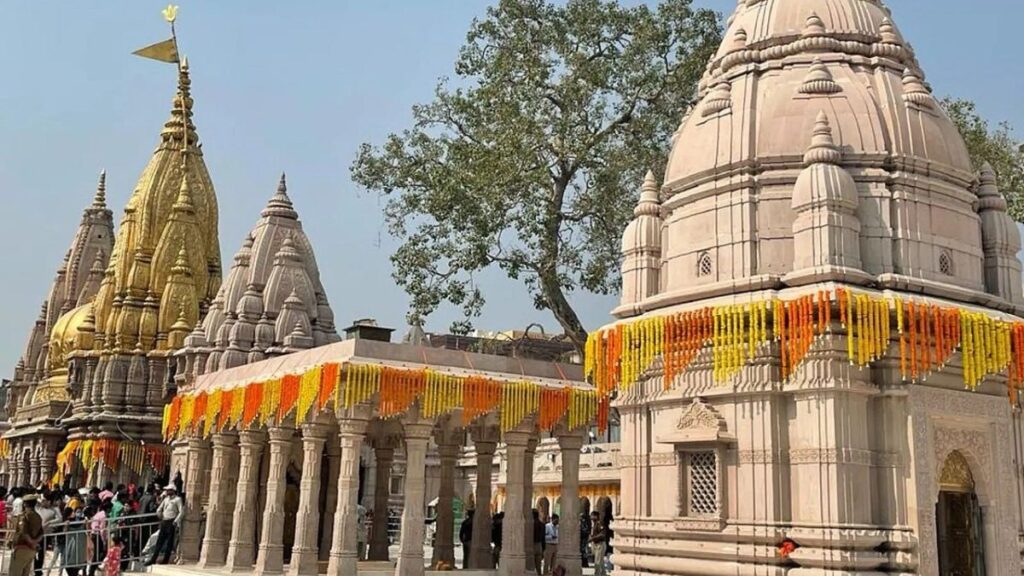
The temple’s main structure features a gold-plated shikhara (spire), which rises majestically above the sanctum sanctorum housing the revered Jyotirlinga of Lord Shiva.
This golden dome, donated by Maharaja Ranjit Singh of Punjab in the 19th century, adds to the grandeur and sacred aura of the Kashi Vishwanath Temple, making it a prominent landmark in the holy city of Varanasi.
The architectural design of the Kashi Vishwanath Temple is built on the principles of symmetry and spiritual geometry.
The sanctum, or garbhagriha, is compact yet powerfully resonant, focusing all attention on the Jyotirlinga. Surrounding this core are several smaller shrines dedicated to other deities such as Goddess Annapurna, Lord Vishnu, and Lord Ganesh, creating a spiritually charged environment.
The temple complex is also known for its narrow, winding corridors and intricately sculpted doorways that reflect the timeless artistry of Indian temple architecture.
Over the centuries, the Kashi Vishwanath Temple has undergone multiple reconstructions due to invasions and natural wear, each phase adding a layer of historical and architectural richness.
Despite these changes, the temple has retained its sacred essence and traditional design elements. The recent Kashi Vishwanath Corridor project has further enhanced the architectural appeal of the temple by improving accessibility while preserving its cultural heritage, thus blending ancient glory with modern convenience.
Also Read: 9 Famous Temples in Mathura You Must Visit
Religious Importance of Kashi Vishwanath Temple
The Kashi Vishwanath Temple is one of the most revered and sacred temples in Hinduism, dedicated to Lord Shiva, the destroyer and transformer in the Hindu trinity.
Situated in the ancient city of Varanasi—often called the spiritual capital of India—the Kashi Vishwanath Temple is considered a gateway to spiritual liberation.
According to Hindu belief, a visit to this temple and a dip in the holy Ganges River cleanse a person of all sins and pave the way to moksha, or salvation. The temple attracts millions of pilgrims and devotees each year, all seeking divine blessings and spiritual peace.
The religious significance of the Kashi Vishwanath Temple is deeply rooted in Hindu scriptures. It is one of the twelve Jyotirlingas, which are said to be self-manifested forms of Lord Shiva, where he resides eternally in a radiant form.
It is believed that even during cosmic dissolution, Kashi (Varanasi) remains intact due to the divine presence of Lord Vishwanath.
The temple has been a beacon of spiritual energy and a place of uninterrupted worship for centuries, surviving invasions, reconstructions, and political changes, symbolizing the eternal nature of divine power.
Beyond its mythological importance, the Kashi Vishwanath Temple also plays a central role in the cultural and spiritual fabric of India. For many, a visit to the temple is not just a religious act but a lifelong aspiration.
It is customary for devotees to chant prayers, offer holy water from the Ganges, and perform rituals in honor of their ancestors here. The temple’s presence in Kashi, where life and death intertwine uniquely, reinforces its status as a sacred place where the mortal connects with the divine.
Also Read: 8 Best Temples in Ayodhya You Must Visit
How to Reach Kashi Vishwanath Temple
To reach Kashi Vishwanath Temple in Varanasi, Uttar Pradesh, you have several options depending on your starting point. Here’s a guide for all major modes of transport:
- By Air:
- Nearest Airport: Lal Bahadur Shastri International Airport (Varanasi Airport), approx. 25 km from the temple.
- How to reach temple from airport:
- Taxi/Auto: Takes around 45–60 minutes.
- Prepaid cabs and Ola/Uber services are available.
- How to reach temple from airport:
- Nearest Airport: Lal Bahadur Shastri International Airport (Varanasi Airport), approx. 25 km from the temple.
- By Train: Nearest railway stations:
- Varanasi Junction (BSB) – 4 km from the temple.
- Kashi Station (KEI) – 5 km from the temple
- Manduadih (MUV) – ~6 km from the temple
- From the station:
- Auto rickshaws, cycle rickshaws, or cabs available.
- E-rickshaws are also common near the temple area.
Also Read: 9 Famous Temples in Vrindavan You Must Visit
Important Information about Kashi Vishwanath Temple
Official Website of Kashi Vishwanath Temple
The official website for the Kashi Vishwanath Temple is the Shri Kashi Vishwanath Temple Trust portal: On the official website of Shri Kashi Vishwanath Temple, devotees and visitors can:
- Book Aarti tickets (Mangala, Bhog, Sandhya, etc.)
- Perform online puja & rituals like Rudrabhishek and Mahadev Abhishek
- Watch live darshan
- Make donations to the temple trust
- Book accommodation in guest houses run by the temple
- Plan temple visits via maps and schedules
- Access temple news & updates
Prasad (Prasadam) Pricing at the Kashi Vishwanath Temple
- Temple-Distributed Boxes: Available directly at the temple counters or via official online reservation:
- 100 g box – ₹ 50
- 200 g box – ₹ 100
- 400 g box – ₹ 200
- Postal/Home Delivery Options:
- Via India Post (Temple Trust + Postal Department): ₹ 251 for Prasad packet (Belpatra, yantras, dry fruits, etc.). (+ ₹ 201 for collection at Varanasi City Post Office)
- Private vendor home delivery: Range varies from ~₹ 599 (standard packet) to ₹ 750 (deluxe box)